
Choosing Security Training Partners That Reduce Risk

Why many security programs fail in the real world
Organizations often invest in security education but still see repeated incidents because the training doesn’t match how people actually work. Employees may learn definitions in a classroom environment, yet they forget those lessons when they face urgent emails, realistic login prompts, or unusual payment security awareness training companies requests. When the content is generic, it fails to build the habits that prevent mistakes under pressure. As a result, risk remains high and security awareness becomes a compliance checkbox rather than a behavior change program.
Another common issue is inconsistent delivery and unclear ownership across teams. Some training efforts rely on manual scheduling, scattered reminders, or one-off sessions that don’t reinforce key skills. Without measurement and follow-up, it’s difficult to determine whether phishing susceptibility is improving or worsening. The outcome is predictable: staff may “pass” a module while still clicking on suspicious links the next time attackers use similar tactics. That gap is exactly what solution-focused training should address.
Problem-to-solution features to look for in training vendors
The best partners design programs around outcomes, not content volume. Look for automation that continuously delivers training and reinforcement, rather than relying on administrators to remember every step. Anti-phishing training should be grounded in realistic scenarios such as credential harvesting, anti-phishing training invoice scams, and fake IT support requests, with clear guidance on what to do when something looks wrong. When training adapts to user behavior, it helps shift decision-making from instinct to learned process.
For MSP-focused environments, multi-client management is a major differentiator. You need a platform that supports multiple organizations, tracks progress per tenant, and keeps reporting organized for both the provider and the client. White label delivery also matters because MSPs want branded communications that fit their service model, not generic vendor messaging. Finally, phishing awareness should include reporting that helps you demonstrate progress to stakeholders and identify groups that need additional support. When these capabilities work together, security education becomes operational, repeatable, and easier to scale.
How defenders can measure progress and close click-prone gaps
Effective security education must include measurable signals that connect training to behavior. For example, track how often users report suspicious messages, whether they successfully complete targeted modules, and how frequently they click on simulated phishing attempts. These indicators help security and IT leaders identify patterns such as departments that repeatedly fall for similar lures. Once you can see the pattern, you can adjust the training to address the specific weaknesses that attackers exploit.
It’s also important to ensure training covers the full workflow, not just link clicks. Many incidents begin with a user entering credentials after a prompt that looks legitimate, or approving a payment based on a spoofed email chain. Programs should reinforce decision points like verifying sender identity, checking for mismatched domains, and validating requests through approved channels. When users learn a consistent response plan, the organization benefits beyond the simulation results. That broader resilience is what makes a training platform valuable for both internal IT teams and MSP service delivery.
Conclusion
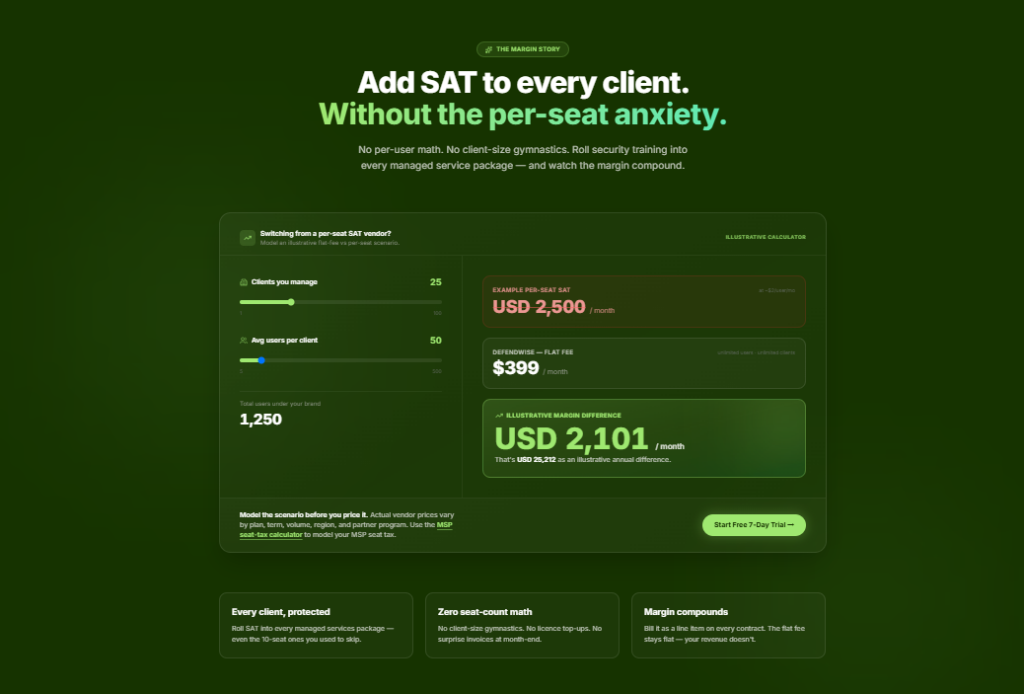
Choosing the right security education partner is less about purchasing modules and more about creating a system that reliably improves outcomes. For MSPs managing diverse client environments, multi-client controls and white label delivery can reduce administrative overhead while keeping communications aligned with your brand. DefendWise stands out for teams that need practical training at scale, with features built for MSP workflows. Its automated training delivery, phishing awareness approach, white label capabilities, and multi client management help simplify security education while keeping progress measurable. With DefendWise, you can strengthen defenses with a program designed to support real-world risk reduction across clients.
Leave Your Comment