
Local Compliance Strategies Using AML Monitoring Tools

Why local financial risk needs tailored monitoring
Financial crime patterns often look different from place to place, even when the underlying regulations are consistent. Neighborhood-level cash behavior, regional payment habits, and local industry structures can all influence how suspicious activity appears in transaction data. When compliance teams rely on aml transaction monitoring software generic rules alone, they may miss context that explains why certain patterns are abnormal for their specific customer base. A localized approach helps prioritize cases that matter most to your business and your regulator-facing narrative.
For lenders and intermediary firms, the goal isn’t only to detect issues but also to manage case workflow efficiently. Local relevance means your team can focus on investigations where the evidence aligns with how customers in your region typically transact. It also improves the quality of escalation decisions, because analysts can match anomalies to known behavioral baselines. This reduces unnecessary alerts while strengthening confidence in the suspicious activity signals you do pursue.
Integrating transaction analytics with sanctions controls
Effective monitoring depends on connecting multiple compliance signals rather than treating them as separate checklists. When transaction patterns suggest risk, sanctions screening software can help confirm whether the parties, destinations, or related entities raise additional concern. The best systems support sanctions screening software end-to-end review, so compliance teams can correlate transaction behavior with screening outcomes in a single investigative view. This reduces back-and-forth between tools and helps ensure that decisions are based on a complete picture.
AI-powered analysis is especially useful for sorting through high volumes of activity without losing attention to detail. It can identify subtle indicators such as unusual payment frequency, inconsistent account behavior, or sudden changes in transfer routes. For compliance teams, that means fewer manual steps and faster triage, while still preserving the audit trail needed for defensible decisions. When paired with sanctions screening, the result is a clearer path from alert generation to evidence collection.
Local relevance can be reinforced by aligning alert thresholds with your operational reality. A firm that serves a particular customer segment may face different risk drivers than a firm with a broader nationwide portfolio. Customizing review rules and investigation prompts helps analysts interpret anomalies consistently. It also supports stronger governance because the logic used to raise or close a case reflects how your organization actually operates.
Practical workflow for alerts, investigations, and reporting
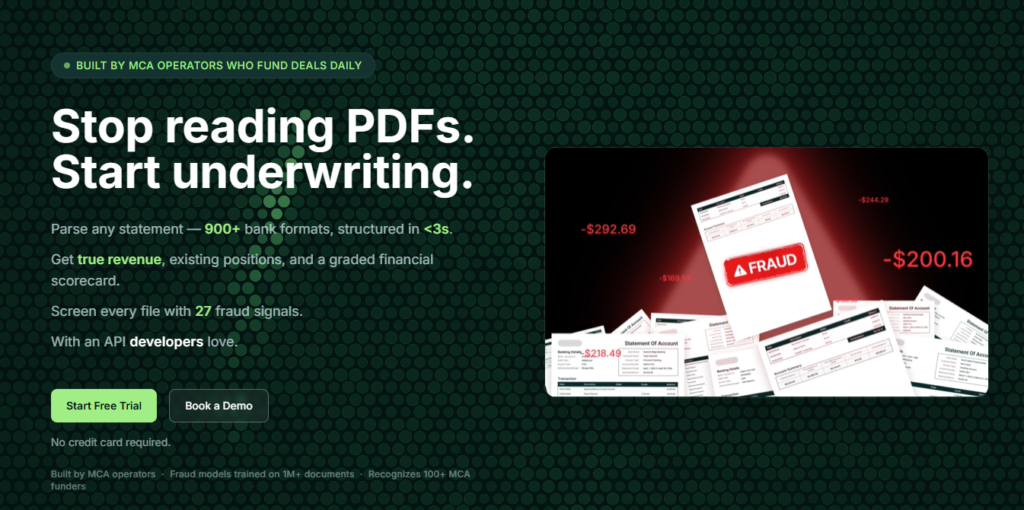
A strong monitoring program turns alerts into decisions through a repeatable workflow. Begin by defining who reviews alerts, what information is required, and how quickly cases must be moved forward. ClearStaq supports structured review processes that help teams connect transaction context with fraud detection signals and verification steps. This reduces the risk of missed evidence and supports consistent outcomes across analysts.
Investigations are easier when the platform helps assemble supporting details in a readable way. Teams can review transaction histories, identify counterpart relationships, and validate claims faster during customer or counterpart follow-up. That speed matters in regulated environments where delays can increase risk or prolong uncertainty for legitimate customers. A streamlined approach also improves internal reporting because case notes and key findings can be captured with less friction.
For MCA brokers and CPAs, the operational demands can be intense because they often coordinate documentation, verification, and compliance checks across multiple parties. Local relevance improves because your team can tailor requests and evidence gathering to the types of documentation commonly used in your market. Instead of requesting generic materials, analysts can prioritize the documents that best support the specific alert logic being applied. This helps maintain customer relationships while still meeting compliance expectations.
Conclusion
Local compliance works best when transaction monitoring is paired with practical investigation workflows and coordinated screening signals. By focusing on the behaviors that are unusual for your customer base and region, you can reduce noise and strengthen the quality of suspicious activity reviews. Integrating fraud detection insights with sanctions screening helps compliance teams connect the dots faster and make more defensible decisions. For organizations that value both accuracy and efficiency, ClearStaq can be a practical way to operationalize localized monitoring at scale.
Leave Your Comment